
Bridging The CAD-To-Simulation Gap: Integrating Meshing-Free Isogeometric Analysis Into Industrial Workflows
Interview with Matthew Sederberg, CEO, Coreform
You presented at CDFAM New York in 2024. What shifts have you seen in how industry is approaching the CAD-to-simulation problem since then, and how has that affected Coreform’s strategy?
At CDFAM New York in 24, the CAD-to-simulation conversation was mostly about speed: how do we reduce manual meshing and preprocessing time to get to results quicker. Two years on, the framing has changed.
Teams are no longer asking how to make meshing faster. They’re asking how to take the human out of the loop entirely, because they want simulation inside automated and increasingly agentic design loops.
The moment you try to automate that loop, you run straight into the meshing and defeaturing step. It’s the one part of the workflow that still needs a skilled human, and it severs the link between the CAD and every other engineering artifact, including the Agent’s understanding of the design and the simulation results. So the bottleneck people used to treat as an annoyance is now a hard architectural blocker.
IGA isn’t only a faster way to prepare a CAD model for simulation. It removes manual meshing from the loop entirely, which is what makes automated design iteration possible.
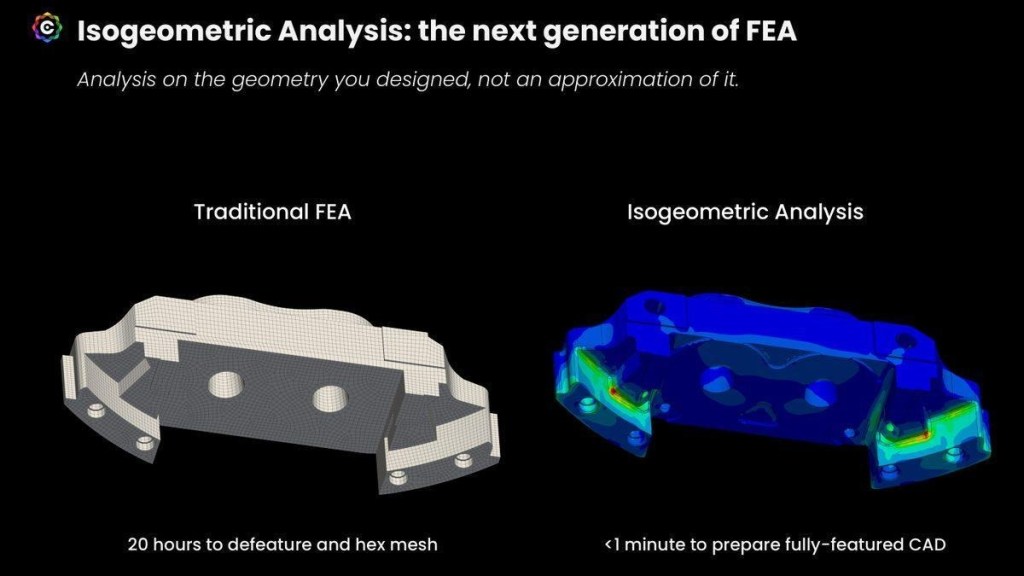
Traditional FEA versus isogeometric analysis on the same brake caliper. Defeaturing and hex meshing takes about 20 hours; preparing the fully featured CAD for IGA takes under a minute, and allows critical features to remain, such as the shoulder fillet where the stress concentration occurs.
Isogeometric analysis has been a research topic for the better part of two decades. What has made it practical to bring into an industrial workflow, and what did it take to integrate it into the Abaqus ecosystem specifically?
IGA has been a beautiful idea since Dr. Tom Hughes formalized it around 2005, but two practical things kept it in the research world. First, initial IGA papers assumed clean, untrimmed spline geometry, and real industrial CAD is messy, trimmed B-rep geometry.
Second, even if you could analyze it, there was no way to integrate this into the solvers engineers actually trust.
Coreform has spent the last decade focused on solving both of these roadblocks. Our trimmed, high-order immersed spline meshes made it possible to build analysis-suitable smooth bases directly on real, trimmed CAD without asking anyone to rebuild their model. That’s the cornerstone.
For Abaqus specifically, Dassault Systemes has been a very helpful partner in enabling the integration of IGA into their solver. While we initially built our own IGA-native solver, Coreform IGA for Abaqus gives us access to the well-known, trusted Abaqus solvers, materials, and workflows. In fact, Abaqus/CAE users don’t need to change a thing about their process except that now they can analyze their fully detailed CAD designs directly, getting both fast insight and highly accurate results, without defeaturing or conformal meshing.
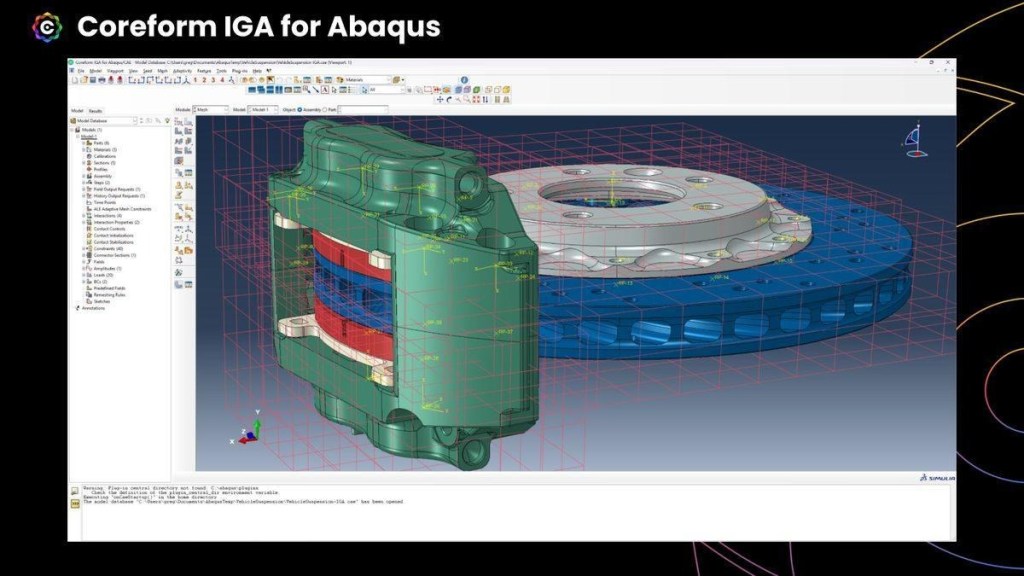
Coreform IGA for Abaqus running inside Abaqus/CAE. The analyst stays in the same interface and runs the same solver, now on fully detailed CAD.
Mesh generation consuming the majority of simulation time is a well-documented frustration. When engineers first remove that step, how does it change the way they approach the design and analysis process?
The hours are the obvious cost, but the more interesting effect is behavioral. When meshing is expensive, engineers ration simulation. They run fewer iterations, they simplify geometry to make it meshable, and they treat analysis as a late gate you pass through rather than a tool you design with. Take that step away and three things shift.
Engineers are able to explore more iterations because the cost of asking each question drops. Engineers stop defeaturing, so they simulate the part they’re actually going to build, fillets and all. And the analyst stops being a mesh technician and goes back to being an engineer.
The thing that surprises people isn’t the speed. It’s that they start asking questions they never bothered with before, because those questions used to cost a day of model prep each and now cost minutes.

A range of analyses run with IGA, from thin-walled parts to fracture and incompressible solids. Removing the meshing step widens the set of questions worth asking.
Working directly on CAD geometry rather than a discretized approximation of it has implications for accuracy, but also for how geometry changes propagate through the workflow. How does that data flow work in practice when a design is still evolving?
In traditional FEA, the mesh is a one-way, lossy snapshot of the CAD. The moment you generate it, the link back to design intent is broken. Change the geometry and you remesh from scratch, reapply your loads and boundary conditions, and revalidate. The mesh is a dead-end artifact.
With IGA, the analysis representation is the geometry, so when the CAD changes the analysis updates with it. Loads and boundary conditions live on geometric features, the faces and edges, that persist as the design evolves, so they propagate instead of being reapplied by hand. That’s exactly what makes an automated loop possible: a design tool, or eventually an agent, can modify the CAD and rerun analysis without a person remeshing in between.
On accuracy, because there’s no defeaturing there’s no geometry approximation error, and the smooth basis captures stress fields well with fewer elements. This is enormously valuable while the design is still evolving.
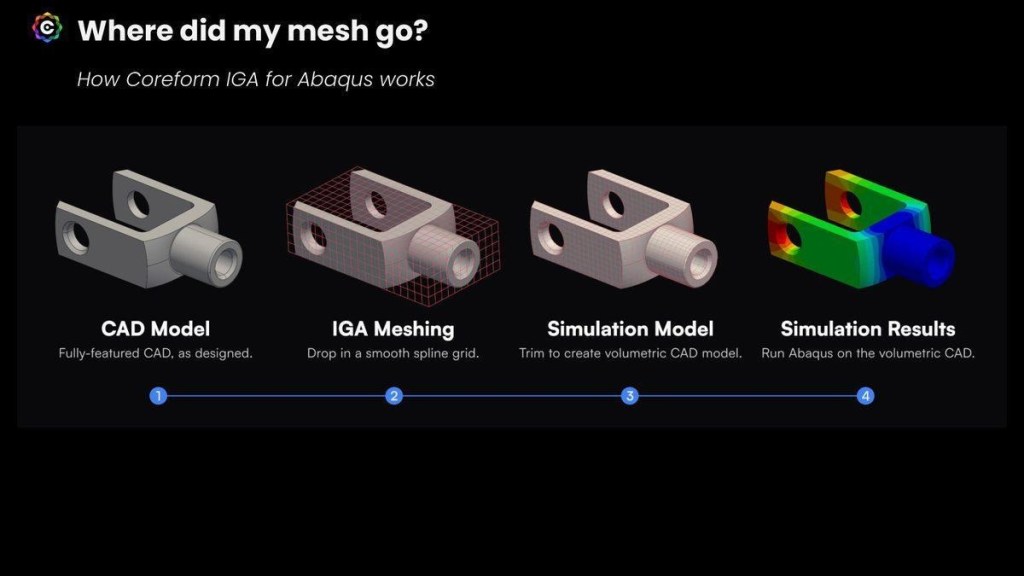
The IGA workflow: start from fully featured CAD, drop in a smooth spline grid, trim to a volumetric model, and run Abaqus on the result. The analysis stays tied to the geometry.
Coreform is operating within established ecosystems rather than asking engineers to abandon familiar tools. What are the tradeoffs of that integration strategy, and where do you see it going next?
The lesson I keep being reminded of in my career is that when you introduce new technology that solves a specific problem, you need to take care that your customer can still complete the entire job they need to do.
My mentor Bob McNeel, the CEO of Robert McNeel & Associates which makes Rhino3D, told this to me repeatedly while I was making the T-Splines plugin for Rhino 20 years ago.
Even if we eliminated a specific pain point, if we weren’t compatible with everything else in the customer’s workflow, then it would be difficult to have them use our solution in production.
At Coreform, we did spend years developing an innovative IGA-native FEA solver. But we realized that matching decades of validated materials, workflows, and solver maturity in Abaqus wasn’t a race we needed to win. That work was already done, and done well.
A higher-leverage move was to bring our unique technology to a solver our customers already trust, rather than spend years rebuilding what they were unwilling to give up anyway. By integrating our technology with other solvers such as Abaqus, we accelerated our go to market by several years and removed switching costs from our customers.
Asking an analyst at a major OEM to abandon a solver with decades of validated material models and institutional trust is extremely difficult, no matter how good your technology is.
Coreform now has a portfolio of IGA technologies we’re developing and deploying with partners, working toward a future where both humans and agents can iterate in fast, automated, trusted ways.
What are you hoping to share and take away from the CDFAM audience in DC this year?
What I want to share is a fairly specific claim: the CAD-to-trusted-simulation gap, and the defeaturing and meshing steps in particular, is what stands in the way of truly automated engineering.
The people at CDFAM are designing the geometry that breaks traditional meshing: the lattices, the organic additive parts, the topology-optimized structures. You feel this problem more acutely than almost anyone.
What I want to take away is to understand the greatest pain points today, and to find a few partners who are pushing the edge hard enough that working together would teach us both something.
We do our best work alongside engineers solving real problems, not in a vacuum, so the hallway conversations matter to me as much as anything on the agenda.


