
Computational Color and Texture for Additive Manufacturing
Interview with Mary Baker – Palace 3D
Mary Baker joins us ahead of CDFAM to discuss her work on computational color and texture for additive manufacturing, covering everything from procedural workflows and AI-generated content to the file formats such as 3MF and tools making it possible.
Below, she breaks down the technical challenges, explains why color and texture are functional tools as much as aesthetic ones, and shares what she’s hoping to bring to the CDFAM in Barcelona this year.

Can you introduce Palace 3D and explain what you’ll be presenting at CDFAM in relation to computational color and texture for additive manufacturing?
Palace3D is a specialized consultancy I launched to bridge the gaps between complex computational design, automation, and high-fidelity additive manufacturing. Palace3D helps companies move into the next generation of functional and aesthetic production.
My background involves developing the end-to-end pipelines required to transform impossible digital visions into scalable, physical realities.
At CDFAM, I’ll be focusing on one of the frontiers in additive manufacturing: computational color and texture.
While industries like animation, film, and gaming have mastered digital appearance, 3D printing introduces a layer of physical constraints such as materiality and structural integrity that we must build ourselves.
I will present workflows for achieving complex geometry-driven color and texture, as-printed color, view-dependent effects, the use of AI tools and generators, and the automation of all of this.

What technical challenges arise when trying to implement visual effects like shimmering, gradient transitions, or embedded data within additive workflows?
The challenges are significant, because we are essentially trying to reconcile what looks like a great solution rendered digitally with what proves to be a good solution when physically instantiated. Here are just a few challenges in enabling this reconciliation. There are many others!
Data bottlenecks – We need to manage massive amounts of voxel-level data or very high-resolution meshes that can crash traditional CAD kernels.
Aesthetic robustness – It looks great rendered, but portions are too weak for the intended print materials and process. How do we automatically make it sufficiently robust while maintaining the aesthetics?
Hardware-specific calibration – A color transition that looks great on a PolyJet machine might be unworkable on MJF or vice versa. It’s necessary to test and calibrate procedural workflows so the render isn’t just a pretty picture but a high-fidelity prediction of the final physical print.

How important is the .3mf file format in supporting the kinds of multi-material, color, and texture features you’re working with, and what advantages have you encountered using it?
3MF is a very important format for additive manufacturing. It allows you to represent geometry, color, texture, translucency, interacting layers of colors and textures, base materials, composite materials, build instructions, and all sorts of things that are important when a design is intended to become a physical object.

Extensions to the core specification allow you to do things like represent voxel data, so you can store information about what’s going on inside the object, not just on its shell.
The beam lattice extension is intended to provide an efficient way of describing complex lattices. 3MF is also a robust format to use in automated workflows, because everything you require, including the materials, textures, scale information, and job instructions, is all wrapped up into one compressed file — essentially a zipped archive — so you won’t find you’ve downloaded a design that’s missing something you need.
You can easily investigate what’s going on in the design — just unzip it and look at the ASCII model files.

What tools or software environments have proven most effective for procedural customization and integrating AI-generated content into print-ready designs?
I approach tool selection based on two criteria: algorithmic flexibility and computational scale. For procedural customization, McNeel Rhino/Grasshopper is a favorite for its accessibility and massive ecosystem. However, for high-density models and automation, SideFX Houdini is my primary environment.
Houdini treats geometry as a stream of attributes that we manipulate to achieve our ends. It excels at managing parts with hundreds of thousands of discrete geometric elements—tasks that often throttle traditional CAD kernels.
Its VDB-based volumetric workflow is particularly effective for generating high-resolution, watertight, print-ready designs from complex procedural or AI-generated inputs. Furthermore, its ability to run as a headless design engine, especially on Linux, allows us to scale these design processes into fully automated pipelines. Integrating AI-generated content into a robust, printable workflow is still a fragmented process.
However, by building custom bridges within Houdini to sanitize and validate AI outputs, we are moving toward a more unified pipeline where generative vision can be reliably translated into functional, additive-ready geometry.



In your experience, how do color and texture influence functional or branding decisions in product development, beyond visual aesthetics?
I believe the distinction made between aesthetics and function is often a false dichotomy, because in many sectors – fashion, consumer goods, signage, etc. – the aesthetic *is* a primary function. But beyond visual appeal, color and texture are critical tools for increasing information density and reducing cognitive load.
Colors help us recognize functionality and meaning quickly. In aerospace or complex electrical installations, color is a regulated safety protocol that enables instant recognition of function. Colors help us differentiate between components. Reading a navigation app in real time is a lot harder without its color coding. I once saw a 3D model of human organs intended for educational use and it was all in one color. Turning the different bits into different colors made it a lot easier to understand. Assembly processes also benefit from color coding of parts.
We’re getting better at modulating translucency in prints, and translucency too is both aesthetic and functional. Being able to see through a structural component to inspect internal fluid levels or sensor placement adds a layer of diagnostic utility that geometry alone cannot provide.
Color might seem like a luxury, but consider the evolution of 2D printers or displays. In practice it isn’t true that stipple patterns can represent the same wealth of data as color (as long as you don’t suffer from a color vision deficiency).
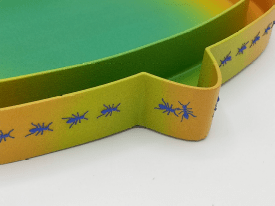
Almost nobody uses a monochrome display anymore! Our world is not monochrome, and as additive manufacturing matures, our created objects shouldn’t be either. Aesthetics and functionality blend together. If you ever visit me in my small house, you’ll find color 3D-printed parts all over – custom face plates, custom storage solutions, brackets, frames, even solutions for keeping ants out of the cat food dishes. Why would I not want these in color?
What do you hope to share with and learn from the CDFAM community through your participation this year?
My desire to participate in CDFAM comes from the incredible expertise the attendees offer. The insights I gained at the New York event were invigorating, eye-opening, and actionable in my own work.
My goal this year is to move from observer to active contributor by sharing my workflows for computational color and texture, with the hope of connecting with others who are pushing these same boundaries.
We are at a point where our vision often outpaces our tooling. To address just one part of the problem, I’ve been developing a robust 3MF importer and exporter for Houdini. Since 3MF is a critical link for high-fidelity color and multi-material data, a powerhouse like Houdini requires this capability. I’d like this to be a collective, open-source initiative to increase the capacity of our community, so I’m looking for feedback and collaborative stress-testing. But more generally, I want to connect with others who aren’t satisfied with our current design ceilings.
How do we want to design what we can’t yet realize?

To connect with Mary and others pushing the boundaries of computational design, AI and ML, engineering, and architecture, join us at CDFAM Barcelona, April 8-9, 2026. Two days of knowledge sharing and networking with leading experts from industry, academia and software development.
Want to convert your dumb STL file, or existing 3MF file into 3MF with Metadata???
Use this batch processor to locally convert, and add metadata to your files that your CAD/CAE software SHOULD be doing for you by default.
Learn more about the free, open source, ISO Standard 3MF specification and how it can help with your additive manufacturing data storage and communication


